Eden and the Garden: God’s plan for Human Stewardship and Expansion
Eden and the garden stand as one of the most fascinating and debated locations in all of Scripture, representing God's perfect design for humanity's first home. The LORD God planted a garden eastward in Eden; and there he put the man whom he had formed." This verse reveals something crucial—Eden was actually a larger region of the earth , and the garden was a specific, cultivated area within it. Understanding this distinction helps us grasp God's original blueprint for human expansion and stewardship of the earth. Eden and the garden weren't meant to be humanity's permanent boundary but rather the starting point for something much greater.
Eden and the garden
Genesis 1:28-31 English Standard Version
28 And God blessed them. And God said to them, “Be fruitful and multiply and fill the earth and subdue it, and have dominion over the fish of the sea and over the birds of the heavens and over every living thing that moves on the earth.” 29 And God said, “Behold, I have given you every plant yielding seed that is on the face of all the earth, and every tree with seed in its fruit. You shall have them for food. 30 And to every beast of the earth and to every bird of the heavens and to everything that creeps on the earth, everything that has the breath of life, I have given every green plant for food.” And it was so. 31 And God saw everything that he had made, and behold, it was very good. And there was evening and there was morning, the sixth day.
Genesis 2:8-9 English Standard Version
8 And the Lord God planted a garden in Eden, in the east, and there he put the man whom he had formed. 9 And out of the ground the Lord God made to spring up every tree that is pleasant to the sight and good for food. The tree of life was in the midst of the garden, and the tree of the knowledge of good and evil.
God's design for Eden shows incredible intentionality and purpose. According to Genesis 2:9, "out of the ground made the LORD God to grow every tree that is pleasant to the sight, and good for food; the tree of life also in the midst of the garden, and the tree of knowledge of good and evil." The garden of Eden was essentially a paradise within paradise—a specially prepared sanctuary where Adam and Eve could fellowship with God while enjoying perfect provision.
The trees weren't just functional; they were beautiful, showing that God cares about aesthetics and human enjoyment, not merely survival. This garden represented the epicenter of God's presence on earth.
The habitability of earth outside the Garden of Eden is a topic that often gets overlooked, but it's essential to understanding God's plan. God looked at everything He had made, including areas beyond the garden and Eden, and declared it "very good." This means the entire earth was habitable and beautiful, not some wasteland waiting to be tamed. The garden was simply the most concentrated expression of God's creative excellence—a training ground, if you will, where humanity would learn stewardship before expanding outward. The rest of Eden and the world beyond were very good and ready for human habitation.
God's command in Genesis 1:28 reveals His expansion plan: "Be fruitful, and multiply, and replenish the earth, and subdue it: and have dominion over the fish of the sea, and over the fowl of the air, and over every living thing that moveth upon the earth." This wasn't just about having kids; it was about spreading God's image-bearers across the entire planet.
Adam and Eve were meant to start in the garden, raise families, and gradually extend the garden-like conditions throughout Eden and eventually the whole earth. Population increase was part of the divine design, not an accident or afterthought.
Where on earth was Eden and the garden
Genesis 2:10-14 English Standard Version
10 A river flowed out of Eden to water the garden, and there it divided and became four rivers. 11 The name of the first is the Pishon. It is the one that flowed around the whole land of Havilah, where there is gold. 12 And the gold of that land is good; bdellium and onyx stone are there. 13 The name of the second river is the Gihon. It is the one that flowed around the whole land of Cush. 14 And the name of the third river is the Tigris, which flows east of Assyria. And the fourth river is the Euphrates.
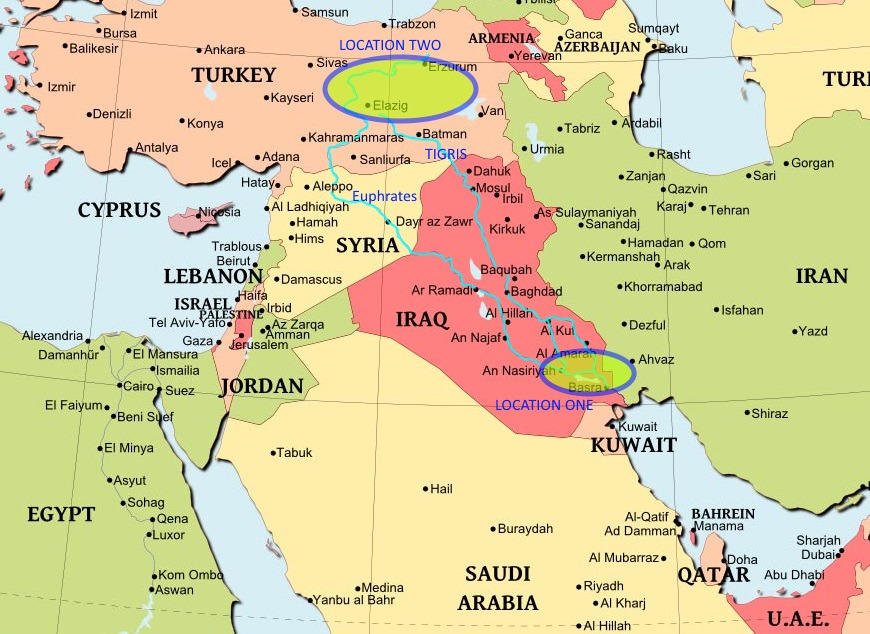
The four rivers mentioned in Genesis provide our best clues about Eden's location. A river flowed out of Eden to water the garden. Leaving the garden, the river divided, and became into four rivers. These rivers are named as Pison, Gihon, Hiddekel (Tigris), and Euphrates.
The Tigris and Euphrates still exist today in modern-day Iraq and surrounding regions, which is why many scholars point to Mesopotamia as the general area where Eden once existed. However, the global flood in Noah's time likely altered the earth's geography significantly, making exact identification impossible.
The first river, Pison, "compasseth the whole land of Havilah, where there is gold" according to Genesis 2:11. This detail shows that even outside the garden, the earth contained valuable resources like gold, bdellium, and onyx stone. God wasn't stingy with His creation—He scattered treasures throughout the earth for humanity to discover and utilize. This suggests that the world beyond Eden's garden was resource-rich and designed to support growing populations. The mention of specific minerals indicates that God expected humans to eventually explore, discover, mine, and develop these materials.
The Gihon river "compasseth the whole land of Cush (Ethiopia"), which has led to various theories about Eden's size and scope. Some scholars believe this refers to the ancient land of Cush, which might have been located differently than modern Ethiopia. What's clear is that these rivers covered significant geographical territory, suggesting Eden itself was a substantial region, not just a small garden plot. The garden was the heart, but Eden extended far beyond it, providing room for humanity's anticipated growth and expansion.
The Hiddekel (Tigris) is described as going "toward the east of Assyria" (Genesis 2:14), and the Euphrates is simply mentioned by name, likely because it was well-known to the original readers. These two rivers still flow through Iraq, Syria, and Turkey today, giving us our strongest geographical anchor point. However, we must remember that Genesis 7:11 describes how "all the fountains of the great deep broken up" during the flood, which would have dramatically reshaped the earth's surface. The pre-flood world likely looked very different from what we see today.
The potential location of Eden has fascinated scholars for centuries, with theories ranging from Mesopotamia to Armenia to even submerged locations in the Persian Gulf. The mention of the Tigris and Euphrates rivers points strongly toward the Mesopotamian region, somewhere near modern-day Iraq. However, Genesis 2:8 specifies the garden was "eastward in Eden," suggesting Eden was the larger region and the garden was positioned in its eastern section. Some researchers propose that Eden encompassed a vast area of the ancient Near East, with the garden as its jewel.
Archaeological and geological evidence for Eden's exact location remains elusive, primarily because of the catastrophic flood described in Genesis 6-8. Genesis 7:19-20 describes how "all the high hills, that were under the whole heaven, were covered" and the waters "prevailed fifteen cubits upward." Such a global catastrophe would have completely rearranged the earth's geography, burying the original Eden under layers of sediment and possibly shifting continents. What we see today is essentially a different world than the one Adam and Eve knew.
more coming in next class after editing what follows
God's design included Adam working in the garden before Eve was created. Genesis 2:15 states, "the LORD God took the man, and put him into the garden of Eden to dress it and to keep it." The words "dress" and "keep" imply cultivation and protection—work was part of paradise, not a result of the curse. This work would have been joyful, fulfilling, and without the frustration and thorns that came after sin. Adam was essentially an apprentice gardener, learning from God Himself how to manage creation, skills he would need when expanding beyond the garden's borders.
The creation of Eve reveals more about God's expansion plan. Genesis 2:18 records God saying, "It is not good that the man should be alone; I will make him an help meet for him." Eve wasn't just companionship; she was essential to the mission of filling the earth. Together, Adam and Eve would form the first family unit, the building block for all human society. Their partnership in both relationship and work modeled how humanity would cooperate to extend God's kingdom throughout the earth. Marriage was designed with multiplication and expansion in mind.
The Garden of Eden featured the Tree of Life, which Genesis 2:9 places "in the midst of the garden." This tree apparently provided some form of sustained life or immortality, as evidenced by God's concern in Genesis 3:22 that fallen humanity might "take also of the tree of life, and eat, and live for ever" in their sinful state. Before sin, Adam and Eve had access to this tree, suggesting they were meant to live indefinitely while fulfilling God's command to fill the earth. Death wasn't part of the original design—it only entered through disobedience.
The Tree of Knowledge of Good and Evil served as a test of obedience and trust. God commanded in Genesis 2:16-17, "Of every tree of the garden thou mayest freely eat: But of the tree of the knowledge of good and evil, thou shalt not eat of it: for in the day that thou eatest thereof thou shalt surely die." This wasn't God being restrictive—He gave them access to every other tree. This one prohibition established that humanity's relationship with God was based on trust and voluntary obedience, not robotic programming. Freedom requires real choices, including the possibility of wrong choices.
The habitability of earth outside Eden is further confirmed by God's provision of food plants everywhere. Genesis 1:29 records God saying, "Behold, I have given you every herb bearing seed, which is upon the face of all the earth, and every tree, in the which is the fruit of a tree yielding seed; to you it shall be for meat." This wasn't limited to the garden—it was "upon the face of all the earth." God prepared the entire planet as a home for humanity, with the garden serving as the starting point and model for what the whole earth could become under human stewardship.
Eden's climate was likely ideal, supported by the unique watering system described in Genesis 2:5-6: "the LORD God had not caused it to rain upon the earth" but "there went up a mist from the earth, and watered the whole face of the ground." This suggests a different hydrological system than what we experience today, possibly involving higher atmospheric pressure, more uniform temperatures, and consistent moisture distribution. Such conditions would have made the entire earth, not just Eden, remarkably hospitable and productive for both plant and human life.
God's plan for population expansion from the garden outward is evident in the structure of Genesis itself. After establishing Adam and Eve in the garden (Genesis 2), the narrative anticipates their offspring and the spreading of humanity. Though sin interrupted this plan, the command to multiply remained. Genesis 9:1 shows God repeating this mandate to Noah after the flood: "Be fruitful, and multiply, and replenish the earth." The word "replenish" suggests filling again what was meant to be filled before, indicating the original plan was still in effect despite sin's interruption.
The garden's eastern entrance, guarded by cherubim after the fall (Genesis 3:24), suggests the garden had boundaries and specific access points. "So he drove out the man; and he placed at the east of the garden of Eden Cherubims, and a flaming sword which turned every way, to keep the way of the tree of life." This implies the garden was a defined space within the larger Eden region, and that Adam and Eve, once expelled, lived somewhere else in Eden or beyond. They didn't cease to exist; they simply lost access to the garden's special privileges, particularly the Tree of Life.
The broader region of Eden apparently remained habitable after the expulsion, as Genesis 4 describes Cain and Abel's activities, including farming and shepherding. Genesis 4:16 even states that "Cain went out from the presence of the LORD, and dwelt in the land of Nod, on the east of Eden." This indicates there were identifiable regions related to Eden, and life continued outside the garden itself. Cain even built a city (Genesis 4:17), showing that human civilization and population growth proceeded according to the original mandate, though now under the burden of sin and its consequences.
Understanding the Garden of Eden and the larger region of Eden helps us appreciate God's original vision for humanity—a vision of expansion, stewardship, and filling the earth with His image-bearers. Though sin derailed the perfect execution of this plan, the mandate remains. Revelation 21-22 describes a future restoration where God dwells with humanity again, and "the tree of life" reappears (Revelation 22:2), suggesting God's original Eden plan will ultimately be fulfilled in the new heaven and new earth. The Garden of Eden wasn't just our past; it's a preview of our future when God's design is finally and fully realized.